February 2011

5 articles in February 2011

As you may have read in last Tuesday’s post, The Light at the End of the Never Ending Tunnel, I was nearing completion of my first draft. Well guess what? I finished it. Yup, that’s right. I found the ending and stopped upon arrival. Of course, now comes the hard part – the Editing stage.

Editing – a Love/Hate Relationship

I’ve read a lot about the editing process in the blogs I follow. So I can guarantee you, I have not been looking forward to this stage. While I’ve been dying to finish draft one, I’ve been dreading the reward – editing. But in reading through blogs, I got a really good suggestion from several sources – read through your first draft as though you are reading a book. Do not start editing or adding content. Just read through it to see how it works as a real book.

Easier said than done, I know. And this is where my Kindle comes in.

After completing my draft, I set out to put my WIP onto my Kindle. This turned out to be extremely easy (click here for instructions). Basically, you get an email account for your kindle then you email the file to the account. For a very small fee (I paid $0.15), Amazon will convert your ‘book’ into an ebook. It then magically shows up on your Kindle when you connect to the internet.

The formatting is not ideal – my paragraphs are not indented, my headings are all wrong – but I can pick up my Kindle and read my words the same way I would read any other book. Plus, I cannot edit while on the kindle.

I am getting a little frustrated with the no editing thing. I read some sentences and cringe, or I see a typo or a place where I inserted the wrong character’s name. And the writing, oh the writing is so loose and I am just dying to tighten it up. But I also see the sense in this plan.

Why don’t I just get out the red pen and go to town?

Before waisting my time editing, I need to make sure the story actually works. I need to know how it is flowing, what things I abandoned halfway down the road without meaning to, or where I can add things that I decided halfway through to run with. By reading it all the way through, I am experiencing it the way a reader would experience it. And if you recall from my post last Tuesday, the reader is who you ultimately want to please.

So far, not so good

I know it is a rough draft, a point I keep reminding myself of, but so far, I’m not impressed. In fact, I’m a bit bored with my writing. Part of this could be that I already know how it will end, but part of it too is that I got lazy with word choice and my sentences are too wordy. But you know what, that’s alright. Because what I got down in the first draft was my story. The details are all there, waiting for me once I can get past the poorly constructed sentences. And once I see how the content works, I can go back and spend hours searching for the best word or the most clever sentence structure. But until then, I’m just not going to worry about it. I’m reading for content, and content only. The rest can all come into play in the next drafts. This read-through is all about making sure it works.

Why?

Without the bones of a good story, no amount of fancy writing will save your book. This is the reality of being a writer. And so I’m willing to suck it up, cringe at the writing I would never pay money to read, and focus on the content.

How do you edit? Do you pull the red pen out and start marking everything up, or do you take your time, immerse yourself in the story first, focusing on that main element, before going crazy with the edits?

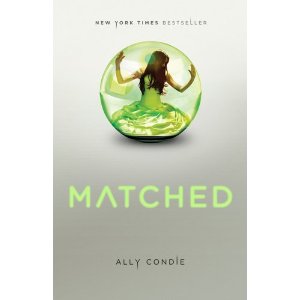
Matched, by Ally Condie

Rating: 5 out of 5

Cassia lives in a world where Society makes all of her decisions: what to eat, what to study, what career to undertake, and, most importantly, who to marry. And Cassia is fine with this. She believes in Society’s decisions, and so when Xander’s face appears at her Matching Ceremony, Cassia accepts that he is her best option for a future mate. Until Ky’s face appears on her chip. Although she is told that it was merely a glitch, that Xander is still her match, Cassia cannot stop thinking about Ky and wondering ‘what if?’. As she questions her Match, Cassia also starts to question Society as a whole and for the first time in her life, she wonders whether Society has a right to control her life.

For starters, the cover is amazing. And once you’ve read this book, you will see how appropriate it is too. If there is any book you are going to judge by it’s cover, let it be this one. Whoever designed this cover, I want them to design the cover for my future books. But moving on to the actual story.

At the beginning of the book, I was reminded of DuPrau’s City of Ember. Cassia’s world is ordered in a similar way to Ember. The citizens are told what to do and they do it. The only difference is that in Cassia’s world, the decisions are made by mathematical equations and super computers. Probabilities determine the best course of action.

As the book progressed, it diverged from City of Ember. Matched is intended for an older audience. The characters and their conflicts are more mature. The consequences more dyer.

Condie does an excellent job creating this new world. The tension and the need to conform to the rules set forth by society drip from the pages. I could clearly see the world; I felt anxiety for the characters, about the decisions they were making, and the ones they were not making.

In addition to the world creation, I also enjoyed the character development. Most characters, even secondary characters, grew as the book progressed. This helped to create a dynamic story. So often in books only 1 or 2 characters show real growth, but I could see the change in many characters as the hold of Society began to slip, as more people began to question the role of Society.

The interactions between the characters was also very well done. There were back stories and different levels of tension, and everything was revealed slowly, adding to the reality of this world and these characters.

All in all, I thought this was a wonderful book and I cannot wait for the sequel.

Ok, I know you’ve heard this from me before, but I am so, so close to finishing my rough draft (and by rough, I mean ROUGH). And I really mean it this time. I’m coming in just at 80,000, I’ve gone through a story arc and I’ve set up the action for the next books in the series. The only problem is, where do I stop?

You’d think since I’m writing a series that this would be the easy part. Can’t I just stop anywhere? Unfortunately, it’s not that easy. In fact, finding an ending for a series might be harder than finding an ending for a single book.

When reading a series, you want to feel satisfied by the ending of the book, but still eager to read the next book in the series. You need to feel like some things were resolved but that there is still a bigger picture in need of a resolution. In trilogies, the second book doesn’t always follow this pattern, but the first book almost always does. If you end too abruptly and leave too many ends untied, your readers may get frustrated. Frustrated readers often times equal lost readers. Losing readers is never a good thing.

So how do you find the perfect ending?

If I had the answer to this question, I’m sure I would have written a million books by now, or at least more than I’ve written to date. So what am I banking on then? That I’ll just know.

My plan is to stop when I think it’s done, then read through it and see how the ending leaves me – do I feel satisfied, disappointed, eager to read the next installment? Based off of my reaction, and eventually my beta readers, I should (hopefully) be able to gauge where it should end. I’ll keep you posted on how it goes. And fingers crossed that I finally finish a first draft.

A few weeks ago I read in a woman’s magazine (not sure which one) that it takes 66 days to make something a habit. The article was talking more about dieting, or exercising, or flossing your teeth. But in reading it, I couldn’t help but wonder if writing couldn’t also be applied to this.

I know I’ve talked about 750words.com before. Since my last post on the subject, I’ve been using it a lot – I’ve entered almost 20,000 words into the site. And I’ve got to say, it’s growing on me.

Making Writing a Daily Habit

Since February is the shortest month of the year, I decided to join the 750words.com 1-month challenge, where I will write 750 words a day for the entire month. I figure if I succeed, I will have reached day 28 in the 66 days needed to form a habit. And once I’ve hit my 28th day, what’s to stop me from writing for 38 more days? And if I manage to do this, will I have succeeded in making writing a daily habit? I hope so.

So far I am on day 7. Not long, I know. But I already feel the need to sit down and get my writing done. And it really is surprising how fast it is to write 750 words. My best time, earning me the Speedy Typist badge, is 12 minutes, but I average closer to 15. In 15 minutes a day, I can write 750+ words. Not too shabby.

My 750 words are not stellar, I know this. But I’m still on the rough draft stage of my book (and I’m almost done). My only concern with the 1-month challenge is that I will finish my first draft before the month is over. But then, is this really a bad thing?

Do you think I can finish the challenge? Do you think I can turn daily writing into a habit? Have you turned daily writing into a habit? How do you fit your writing time in? Is 15 minutes a day enough time? Or do you need more time to write a first draft?

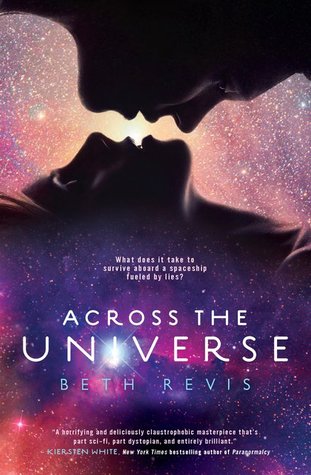
Across the Universe, by Beth Revis

Rating: 3 out of 5

Amy, 17, is cryogenically frozen so that she can join her parents on a special mission to a new planet, one that will take 300 years to get to. 50 years prior to their scheduled landing, Amy’s cryo chamber is unplugged. Not only does she almost die, but she is now stuck on the ship, unfrozen and an outsider. When additional ‘frozens’ are found unplugged, Amy teams up with Elder, next in line to rule, to find out what’s going on before anyone else, including her parents, dies.

There was a lot of hype leading up to the release of this book, and I was incredibly excited about it. The concept alone was enough to make me rush out and buy it. But as I started reading it, I found my excitement ebbing.

The story is well-developed and the world is richly described and convincing. I guessed at some of the twists, but the majority of them came about in unexpected ways and with unexpected consequences. The one element that took away from the story was the use of voice.

Across the Universe is told in first person, but split between two narrators – Amy and Elder. I did not feel that either voice was developed enough for me to easily identify the speaker. I had to keep flipping back to the beginning of the chapter to see who was telling the story and I even thought Elder was a female for several pages into his first chapter. I’ve read other books where first person narration is split among two characters. For this to work, the voices need to be very well-developed (check out Leviathan for an excellent example). Because this fell short for me, it took away from the story. I kept getting distracted, trying to remember who was talking.

Despite my issues with voice, I thought the story was original and intriguing. Not only does Revis tell a good story, but she alludes to some deeper issues that make you think. I can see several English class/book club discussions coming out of this book.

Do I think you should give this book a shot? Yes. It’s worth the read.