November 2011

4 articles in November 2011

The internet has been buzzing all week. The Hunger Games movie trailer is finally here.

I’ve watched the trailer a few times and I’m left with mixed feelings. The gritty scenes don’t seem to be living up to my imagination – they feel a bit too clean – but the glamour of the Capitol is working for me. The actor choices could work, but I need to see more to be completely sold. Of course, it’s hard to tell much from a preview. One thing I will say for this trailer is that it did not give away the movie for those who haven’t read the books. What do you think about the trailer? Did it get you excited for the movie, or were you left feeling a bit blase?

I’ve watched the first three episodes of ABC’s Once Upon a Time, and I’ve got to say, I’m really loving it. It’s a lovely combo of real life meets fairy tale with a dash of dystopian. Based off of the growing interest in reworked fairy tales and the continued popularity in dystopian fiction, it’s a pretty clever mix.

If you haven’t seen it, Once Upon a Time takes all of the fairy tale characters we know and love and, due to a curse meant to take away their happy endings, they are transported to Storybrook, Maine, where they are locked in a prison of mundane lives.

What I love about this show

First, have you ever been to Maine in the winter? I cannot think of a more perfect place to to send people if you want them to live out miserable lives. Not to say I’ve got anything against Maine, but even the most die hard Maine fan has to admit, it’s desolate and down right scary in the winter.

The second thing I love about it is that it takes the story of Snow White and mixes it up. As the story progresses through the episodes, we are shown pieces from before the curse juxtaposed with scenes from post-curse. Think Lost, which, since Once Upon a Time was created by two of the writers from Lost, makes sense.

Reworking Fairy Tales

Reworked fairy tales, when they work, are wonderful. There is comfort in already knowing the main characters, but there is also an added interest in not knowing how the events will play out. And I’ve got to say, so far the reworking and expansion of this fairy tale is proving to be quite successful. I cannot wait to see more.


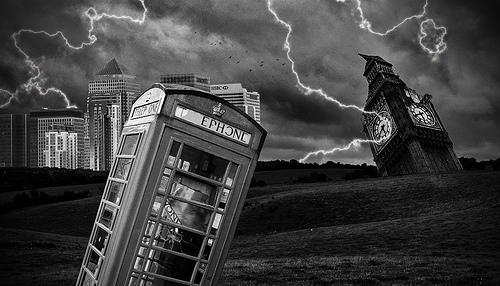
Photo by: Jon McGovern, http://www.flickr.com/photos/jonmcgovern/

I’m sure few people would disagree that dystopian is huge right now. And it’s not just the Hunger Games trilogy that is drawing readers to this genre. But why do people like reading dystopian? What’s the appeal?

Dystopian What?

For those of you that do not know what dystopian books are all about, here’s a quick primer. Basically, dystopian fiction depict dystopian society (the opposite of a utopia). These books often have elements of science fiction and usually also fall into the parameters of speculative fiction. Some classics include Huxley’s Brave New World, or, one of my favorites, Orwell’s Nineteen Eighty-Four.

More recent dystopians include The Hunger Games, The Maze Runner, The Uglies, Matched, and XVI. For a list of additional dystopians, check out the Goodreads Dystopian List and the Dystopian Book Club list from the Teach 8 YA Book Blog.

Why Dystopia?

I’m sure everyone has their own reasons for why they love dystopian fiction. For me, I have several. While it comes off sounding a bit glass half-empty, seeing how much worse life could get actually makes me feel more optimistic and hopeful. If things could always get worse, maybe any troubles in my life aren’t as bad as I think.

Then there is the sci-fi element. I enjoy sci-fi, but only when it doesn’t go too far. Most of the dystopians I enjoy, and the ones I’m currently writing, have elements of sci-fi but they keep them vague. They give just enough. I like to refer to this as casual sci-fi.

And then there is the alternate history or the possible future, which I think of as reverse history. In my 9-5 life, I think a lot about history. I’m a trained archaeologist, after all. Most of the successful dystopians I’ve read have a good grasp on history and sociology. They ask what-if and then take it to the next level, exploring what could actually happen were the what if to come to fruition. The realism behind most dystopians is extremely appealing.

To me, dystopians are the ultimate sociological experiment. But the writers also tell good stories full of all of the plot elements we have come to expect from any good book, regardless of genre. So if you like a good story but also enjoy those make-you-think moments that dystopians are so good at inducing, then dystopian fiction may be for you.

If you haven’t read a dystopian novel, go ahead and give one a shot. The worst that could happen is that you end up not liking it. Or you could discover an entire genre you never knew you loved.

If you already are a dsytopian fan, why do you like them? What’s your favorite dystopian novel?


As a follow-up to my previous blog post, I am reimaging my blog for my intended book audience, YA dystopian fans. Before this decision, the blog was a bit of a mess, with zero consistency and no real targeted audience.

Why should you care?

If you do not like dystopian YA, you may no longer be interested in the blog content. If you do like dystopian YA, then this blog is for you. If you know anyone who likes dystopian ya, then you may want to recommend this blog. And if you have no clue what dystopian YA is, you just may learn something.

This change doesn’t mean that I won’t still share posts about my writing process or industry trends, but as much as possible, the blog will have a dystopian YA focus.

I hope you enjoy the changes. And for those of you who have no clue what I’m talking about, stay tuned for my next blog post, The Dystopian Appeal.