May 2012

11 articles in May 2012

I made a startling realization today. My main character and I are not interested in the same things. In fact, her favorite subject is the one subject in school that was always beyond me – science. And you know what is even worse? I realized that I’ve written another character in another work-in-progress that has these same interests.

As a writer, it seems like it would be easy to model my characters after me, to give them my hobbies and my interests. But did you ever have to draw a self-portrait in an art class? If so, you probably know how difficult a thing it is to try to recreate yourself. I could draw other people’s’ portraits, showing their flaws and beauties and making the entire thing come together in a wonderful recreation of that person, but when I sat down to do myself, all of my self-perceived flaws flew to the surface and there was nothing I could do to add in the beauty. And even worse, I couldn’t even get the flaws right because I wanted to downplay them. When things get too personal, bias creeps in. And bias rarely allows for a full story to be portrayed, just like it keeps a portrait from being complete.

This is not to say that my characters do not have bits of me inside of them. Often I substitute in a fear or an insecurity or a quirk or a personality trait. I may make my character shy or overly chatty when she is uncomfortable. Or I might go the opposite and, instead of adding in my insecurities, I may make that character confident about the things I lack confidence in. Adding in emotions I know help make the character more real.

I also add bits of other people I know, but I never make a character a spitting image of someone I know. Instead I may take one of my insecurities and mix it with my friends facial features and my brother’s talent and my other friend’s strange quirk. This allows me to create a dynamic, unique character. This is what helps me to make my characters real.

Unfortunately, though, to make a character real, you have to be able to write in real details. Meaning, if you character is interested in science and genetics, I, as the writer, have to research science and genetics so that I can add in little tidbits throughout the narrative, things that will tie back to the main character’s interests and personality and help bring the story alive.

So who knows, maybe by the end of the summer I will have a better grasp on science or at least be able to convince people through my writing that I have a grasp on it.

How do you come up with inspiration for your characters? Do you research their interests or do you try to give them your own interests?

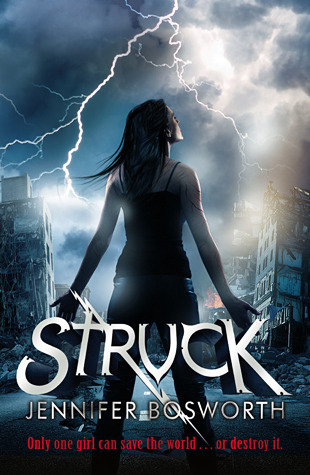
Struck, by Jennifer Bosworth

Rating: 3 out of 5

Summary: Mia Price is a human lightning rod, or so it seems. She cannot go out into a storm without getting struck, yet, somehow, she always manages to survive. Embarrassed by the scars that cover her body and scared that people will get hurt if they stand too close to her, Mia tries to keep to herself. Following an earthquake that devastated Los Angeles, and which some people claim was caused by lightning, Mia is finding it harder to stay in the shadows. Cult members from an evangelical church led by a man name Prophet are hunting Mia along with another group that is fighting against Prophet, known as the Seekers. And both groups keep telling Mia that the world is coming to an end and that its fate rests on her shoulders. To complicate matters, the mysterious, attractive boy Jeremy keeps urging Mia to stay away from both groups. As the End nears, Mia’s must decide – is fate written, or can it be changed.

Disclosure: I received an ARC of Struck from www.almostgrownup.net.

All in all, this was not a bad book, but I did not think it lived up to its potential. The premise is great – a girl who controls lightning, the end of the world, and secret cults. But once I got past the premise, the book fell short for me.

The biggest problem was that I didn’t really feel invested in the characters. I didn’t care if they lived or died. I didn’t want to see the world end, so I had to side with the people trying to save it, but otherwise, I didn’t have anything to root for.

I also found the plot to be a little overcomplicated. There were a lot of unanswered questions. The logistics of the powers didn’t really make sense to me. In Ashes, some of the characters seem to acquire special powers after an EMP, but the logic behind this is explained and seems plausible enough. I would have liked to have seen some sort of explanation about how the people who got their powers were chosen. Otherwise, it just seems a bit too random.

I thought I was going to have a bigger issue with the religious aspects of the book, but I thought Bosworth handled them nicely. So often in apocalypse books the religious elements become too intense and preachy, but Bosworth did not get preachy. Rather she showed us a cult that played on people’s’ fears. I’ve seen people turn to religion after traumatic events, so this seemed like a relevant addition and I thought Bosworth handled it with grace.

As an easy beach summer read, this book would work, but if you have a stack of things you are dying to read, I would probably recommend reading them first.


One of the biggest problems with being a writer is that you feel like everyone expects everything you write to be brilliant. For the past year I’ve been working towards converting to Judaism. And the big day is finally almost here. But first, I have to write a statement of intent. Only problem is, instead of just worrying that what I write won’t show that I’m committed and serious enough, I’m also worrying that my writing will not seem brilliant enough. I can’t just write my thoughts. I feel the need to stream together amazingly poetic prose.

Do you find that you have this problem? Do you feel that people expect more from you when you are a “writer”? Or have you found a way to turn off the writer brain so that sometimes you can just write for the sake of writing?

Whenever I come up with a story idea that I’m excited about, I share it with the fiance. And, more often than not, he says “oh, that sounds like [insert already published book].” Then I get frustrated and decide my idea is not good enough and move on to something else. But you know what, there are few original core ideas left. It is how you alter the core, the bits you add in, like your characters and your setting, that make it unique.

I read a post over at Writer Unboxed, Write Like a Comparative Mythologist, that summed it up really well:

Even if you are telling ‘essentially the same story’ as someone else, you are not ‘ripping off’—you are adding to the conversation… If you view your story as another answer to the same issue, then you will realize that as long as you are sincerely dealing with the issue, you cannot ‘rip someone off’ just for having a similar premise.

This is good advice to remember when someone tells you “oh, that reminds me of…” or when you read something that has a similar concept to your own WIP. It’s easy to get overwhelmed and frustrated, but instead of letting that frustration get you down, use it to work harder to make your work stand out.


I’m currently enrolled in an online writing course – Writing the Young Adult Novel – through Writer’s Digest University and, as is inevitable with any writing course, there are critiques.

Critiques are, unfortunately, part of being a writer. Anytime someone reads what you wrote, they are going to critique it. Sometimes they give you the feedback, sometimes you read it in the form of a review, and sometimes they think it but never give words to their thoughts. Even though I hate waiting for a critique and psych myself out, I would much rather actually receive one, especially if it includes constructive criticism, than to have no idea what people think of my work.

Waiting for my first critique was very stressful. But you know what, the stress was unfounded. In fact, it wasn’t a bad critique. What has turned out to be more difficult is critiquing the work of the other students. I want to provide constructive criticism while also providing encouragement. This is not the easiest thing to do. When I work in publishing, I often had to compile the critiques made by beta readers and then deliver them to authors. I’d like to think this work and reading all of the reviews to compile summaries, has helped me to write better critiques. But I know that’s not true. I know that when it comes to being brutally honest, I would rather sugar coat. Maybe it’s all those years I spent living in the south. Or maybe it’s because I know how devastating a negative critique can be.

When it comes down to it though, if you can’t stomach an honest critique, you won’t go far as a writer. In writing critiques for my classmates, I am appreciating just how difficult it is for editors and agents to respond to queries. I am also improving as a writer by learning to identify what works and what does not work. While the critique process is difficult, both the give and the take, I know it is helping me to become a stronger writer.

How do you feel about critiques? Do you give them? Are you brutally honest or do you try to sugar coat things? How do you find people to critique your own work?

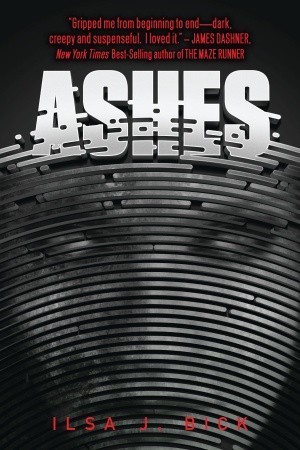
Ashes, by Ilsa J. Bick

Rating: 5 out of 5

Summary: Alex is dying. She has a brain tumor that can’t be cured and she can tell that she is getting worse. Determined to die in peace, Alex takes a trip out to the woods to scatter her parents ashes and come to terms with her own mortality. And then the unthinkable happens. An EMT goes off, killing all electronics and casting the country, and, possibly, the world, into a state of chaos.

With the help of Tom, a young soldier, and Ellie, a young girl whose grandfather and only family member died in the EMT, Alex struggles to survive in this new world, where millions are dead and the survivors are mostly untrustworthy or worse, extremely deadly.

I don’t want to give away too much more about this book. I think what made it so engaging for me were all of the surprises and twists. It has been a long time since I read a book that kept me guessing and on the edge of my seat – this book did that and more. While there were a couple of things I guessed, I did not see the ending coming at all. And I’m dying to read the next book.

Great Characters

For starters, the characters all have depth. Even the minor characters were 3-dimensional. Everyone had something they were fighting for and I believed everyone’s story.

The main character, Alex, was very well done. She had layers and she grew in a very believable way. I could make sense of her decisions and understand her feelings. The same was true for Tom and, while she was a little obnoxious at first, even Ellie.

I did have a slightly harder time with a couple of the characters later in the book, mostly in Part 4, but I don’t want to say anything about them because that would ruin the suspense. I will say, though, that Part 4 got a little weird for me, but it was worth sticking it out to get to Part 5.

Genre-defying

I’m glad I went into this book knowing very little about it. I thought it would be your typical apocalypse story, which in some ways it is, but in other ways it is not. Had I known more about it, I may not have read it. But I’m glad I did because this book does not fit neatly into any of the boxes it could be put into, genre-wise. Even if you have heard some things that make you think you don’t want to read it, you really should give it a chance. I promise you will not regret it.


I love my work-in-progress, but sometimes, we need to take a little time out. Sometimes, I get an idea for something else and it just won’t leave my mind. It consumes the creative parts of my brain, distracting me from my project and making writing time difficult. When this happens, I’ve found it to be more beneficial to take an hour or half a day or even a day off of my work-in-progress to write the scene or character sketch or plot outline that is distracting me. Then, when I return to my work-in-progress, I’m more focused.

What do you do when a competing interest jumps into the spotlight? Do you take a time-out  or do you try to push through, ignore the urge and force yourself to focus on your current project?

I just joined a Book Blog list. Basically, anyone who reviews books and blogs about it was invited to join. Since I love reading book reviewer blogs and love blogging about books, I figured this was a good way to reach out and meet some more bloggers. I encourage everyone to visit these blogs. If you want more information, check out The Masquerade Crew.

Also, if you are a book blogger, you can add your site to the list below. If you do add your site, please also include this list on your site. There is a link below the list to add the list to your site.

Happy Reading!


Get the InLinkz code

Photo by: Stephen Coles, http://www.flickr.com/photos/stewf/

Research is important for a successful novel regardless of your genre. When I first started writing, I figured research was only necessary for historical fiction or Michael Crichton-type thrillers. I was certain that fantasy and futuristic writers didn’t need to bother with research. I mean, they build their own worlds. What’s there to research?

But boy was I wrong.

Research, Research, Research: Examples from the Real World

Think about the last novel you read. Now think about the details. As an example, I will use one of the last novel I read, Wondrous Strange. In this urban fantasy, the main character, Kelley, is an actress in a Shakespeare play and fairy lure is laced throughout the book. There are also other fantastical characters. To write this book, Lesley Livingston needed to be familiar with fairy tales from different cultures. She also needed to be familiar with a variety of Shakespeare plays and other fantasy creatures and the folktales that accompanied them.

My current WIP is set in the future. Like it or not, writing a book set in the future also requires research. While it is not a hard sci-fi book, readers will expect some sci-fi elements. What does the future look like? What new, amazing technology have they developed? To figure this out, I have to spend time looking at trends in technology and science and, based off of these things, make educated guesses about what these things will look like in the future.

Where do I go to Research?

Two of my main sources of research are TechCrunch and Mashable. TechCrunch blogs about technology startups and Web 2.0. Mashable is  a news blog that explores web technology, news, new websites/social networks, etc. I also skim the technology and science sections in several online newspapers and follow NASA and Astronomy Magazine on Twitter. A lot of days, I don’t see anything that sparks my creativity. But sometimes, I get a little nugget that grows into an amazing idea.

Take my current WIP. The main premise came from a news story. I occasionally listen to a podcast called Mysterious Universe. I was listening to it one day and they were talking about solar flares and underground homes that are being built to protect people from these flares. So I went to the internet and started researching these things and the idea took off. What if there was a solar flare that destroyed earth and the wealthy escaped in a space ship and return years later, thinking Earth was uninhabited only to discover that people had been living in underground safety pods. Cue conflict.

No matter what genre you are writing in, you will always need to do your homework.

How do you research? Do you use research for inspiration?

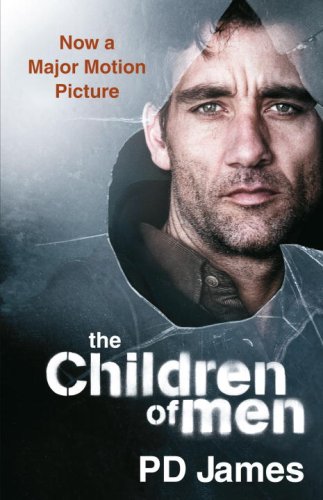
The Children of Men, by P.D. James

Rating: 3 out of 5

Summary: The year is 2021 and mankind is on the brink of extinction. The last generation has reached adulthood and despite fertility testing and years of scientific research, mankind remains infertile. Mass suicides are on the rise as the citizens of England begin to lose hope. Theodore Faron, an Oxford historian, is stuck in the past. He would rather remember his unhappy past then think about the future-less future. Until he is approached by Julian, an attractive, smart woman who wants him to help her and her group of revolutionaries, the Five Fish, convince Theo’s cousin, the Warden of England, to step down and let someone else rule the country. As Theo becomes more involved with the group, he begins to realize that his future may not be so hopeless as he discovers that the Five Fish have a secret that could mean the survival of the human race.

While this is not really a YA novel, I’ve noticed that a lot of people on GoodReads who enjoy YA dystopians have added this book to their to-read lists. Personally, I have wanted to read this book for a long time because I loved the 2006 movie adaptation. Unfortunately, very quickly into the book I realized that the movie adaptation was a very loose adaptation. About the only similarities are the main concept and the character names. Otherwise, they may as well be two completely different stories with more or less different plot lines and characters.

The Good

James’ writing is, without a doubt, beautiful. She uses interesting words in interesting ways and her use of description is quite good. The characters, for the most part, are interesting with a healthy dose of weaknesses. Theo has an interesting story and he grows throughout in ways that seem believable. Miriam and Julian were also interesting and I found myself wanting to know more about their backgrounds. I wish Luke and Rolf, the other members of the Five Fish, had been equally as developed. Xan, the Warden of England, was also well portrayed. Despite his weaknesses, I did not find him to be completely bad and, even though I knew his success would mean the failure of the hero, I was conflicted about wanting him to fail. I kept hoping that a compromise could be found. I think this shows that James successfully created her characters because you should always feel something for both the hero and the villan.

The plot, while slow at times, kept me guessing. James moved the plot in interesting ways and made good use of surprises. Even when things seemed predictable, I still found myself engaged in seeing how the predictable parts would come to pass.

Finally, the general concept is intriguing. I loved seeing how James painted a world on the brink of destruction, seeing the different responses and how different people dealt with the inevitable end and the failure of mankind to reproduce, something so innate and something that other, seemingly more inferior beings like cats, are still able to do.

The Not so Good

The book is written in third person with pages from Theo’s diary added in to provide his background. It was an interesting convention, but I was not overly fond of it. It almost seemed like an easy way to give us the background into Theo’s life. I would have preferred learning about his life throughout the flow of the novel. His diary entries bordered on boring and, were it not for the fact that I enjoyed the movie so much, I probably would not have been able to make it through this book.

The book did not really get interesting for me until about 200 pages in. The book only has about 250 pages. I’m not sure if seeing the movie, which was so very different, made me enjoy the book less than I would have otherwise or if it made me enjoy it more.

While I didn’t love the book, I am happy that I read it. P.D. James is a lovely writer and she made an interesting exploration into mankind’s nature and how we would deal with such an inevitable end.